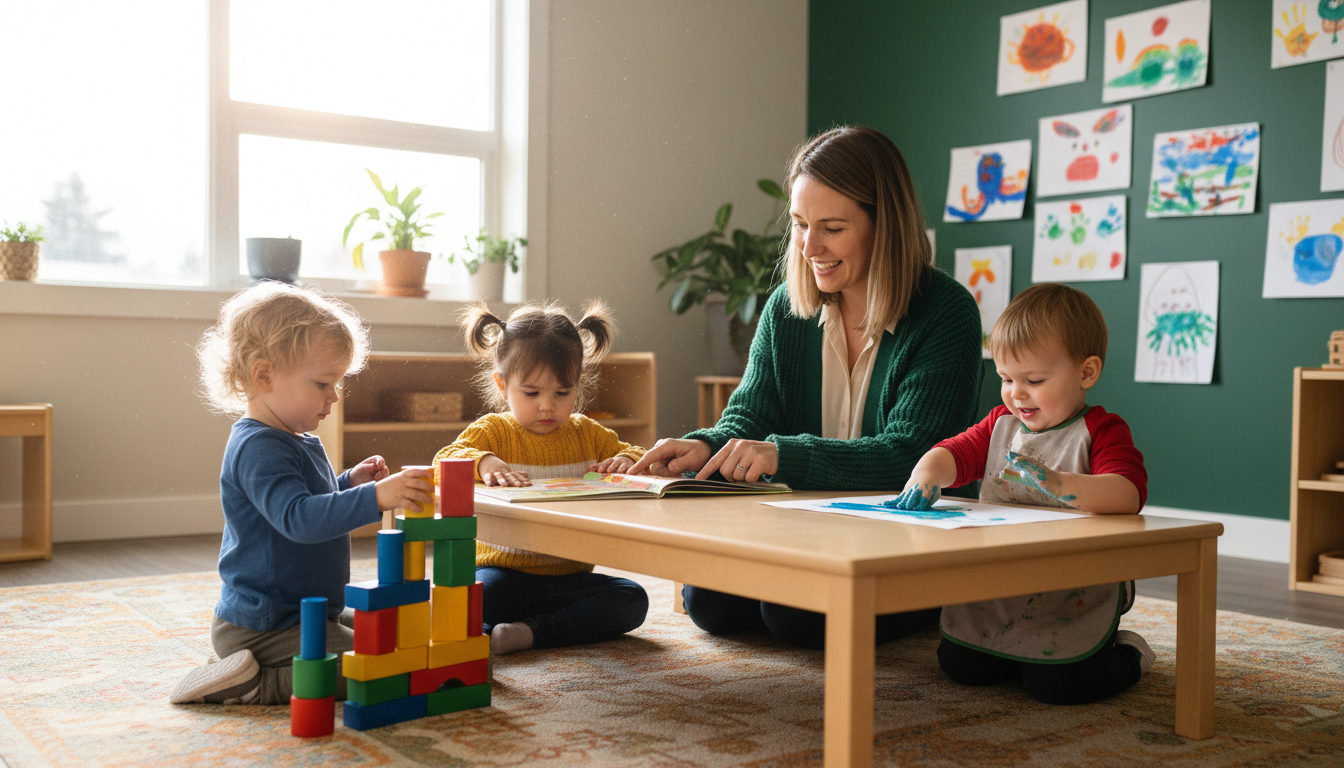


Toddler art activities do far more than produce colourful paintings for the fridge. For infants and toddlers aged 12 months to 3 years, open-ended art is one of the most powerful developmental tools available — building fine motor skills, supporting language development, teaching cause-and-effect, and supporting emotional regulation. At Smiling Kids Childcare Centre in Coquitlam, art is woven into our daily programming for our infant and toddler rooms. Here’s what the research says and what parents can expect. For our toddler programme: toddler daycare Coquitlam BC.
What Toddler Art Really Develops
When a 2-year-old scribbles with a fat crayon, they are not just making marks. They are:
- Building fine motor strength: Gripping, pinching, pressing, and sweeping all develop the small muscles needed for later writing and self-care tasks
- Learning cause-and-effect: Press hard → darker mark. Add water → paint spreads. These are early science concepts delivered through sensory experience
- Developing visual-spatial awareness: Filling a page, leaving space, choosing where to make a mark — all spatial reasoning
- Practising pre-literacy skills: Left-to-right hand sweeping mirrors the directionality of writing. Mark-making is the developmental predecessor to letter formation
- Building emotional vocabulary: “I made a big mess!” “It’s red like fire.” “I’m angry — look at my painting.” Art gives toddlers a nonverbal outlet for complex feelings
- Developing self-regulation: Waiting for a turn with the glitter, choosing when the painting is “done,” cleaning up — all self-regulation practice
Age-Appropriate Art for Infants and Toddlers (0–3 Years)
Infant Art (6–12 months)
True art for infants is sensory exploration:
- Edible paint (yogurt + food colouring, pureed beets) spread on a tray — safe for mouthing
- Textured paper for exploring by touch and crumpling
- Water painting on dark paper (disappears safely)
- Ribbon streamers for visual tracking and grasping
The goal at this age is not a product — it is sensory input and hand-eye coordination development.
Young Toddler Art (12–24 months)
- Fat washable crayons and large paper (the bigger the better — reduces frustration with missed marks)
- Stamp pads with large foam stamps
- Watercolour painting with fat brushes
- Playdough manipulation (squeezing, poking, rolling) — builds the same hand muscles as mark-making
- Sticker placement on paper
- Leaf and texture rubbings with crayons
Older Toddler Art (24–36 months)
- Scissors (child safety scissors — cutting practice is crucial for fine motor development)
- Collage making with torn paper, fabric scraps, and natural materials
- Drawing with intention (toddlers begin naming what they’ve drawn even if it’s not recognizable)
- Simple weaving on cardboard looms
- Nature printing — pressing leaves and textured objects into paint
- Clay exploration (air-dry clay is appropriate from about 2.5 years with supervision)
What Toddler Art Reveals About Development
Qualified ITE educators can read significant developmental information from toddler artwork:
- Mark-making progression: Random scribbles → controlled scribbles → named scribbles → pictographic marks follows a predictable developmental sequence. Departures from this sequence, or regression, can signal developmental concerns worth monitoring
- Grip development: The shift from fist grip to tripod grip (thumb + two fingers, like holding a pencil) typically occurs 24-36 months. Educators observe and support this transition
- Hand dominance: Hand dominance is usually established by 3 years. Before that, switching is normal and healthy — don’t push a toddler to use a specific hand
- Colour use and emotional expression: Research in art therapy suggests that children experiencing high stress or significant life changes (new sibling, centre transition) may shift their colour palette. Educators notice and explore this with sensitivity
Process Art vs. Product Art — Why We Prefer Process
At Smiling Kids, we follow the process art philosophy: the experience of making matters more than the outcome. This means:
- We don’t use adult-created templates for children to colour in (these prioritize the product and create failure experiences for toddlers who can’t stay in the lines)
- We never compare children’s work or comment on what something “is” until the child tells us
- We ask process questions: “How did you make that texture?” “What happened when you mixed those two colours?”
- We value the mess — messier art usually indicates deeper engagement
Art at Smiling Kids Coquitlam
Art experiences at Smiling Kids are planned weekly by our ITE-certified educators and drawn from the BC Early Learning Framework’s emphasis on creativity, play, and inquiry. Our dedicated art area in both infant and toddler rooms includes rotating media and materials. Parents see their child’s art process through daily reports and monthly portfolio pages.
More on our toddler programme: toddler care Coquitlam BC | play-based learning at daycare | toddler language development at daycare.
Book a Tour at Smiling Kids
See our art programme and Coquitlam infant and toddler rooms in person. Call 604-600-4393 or contact us online.