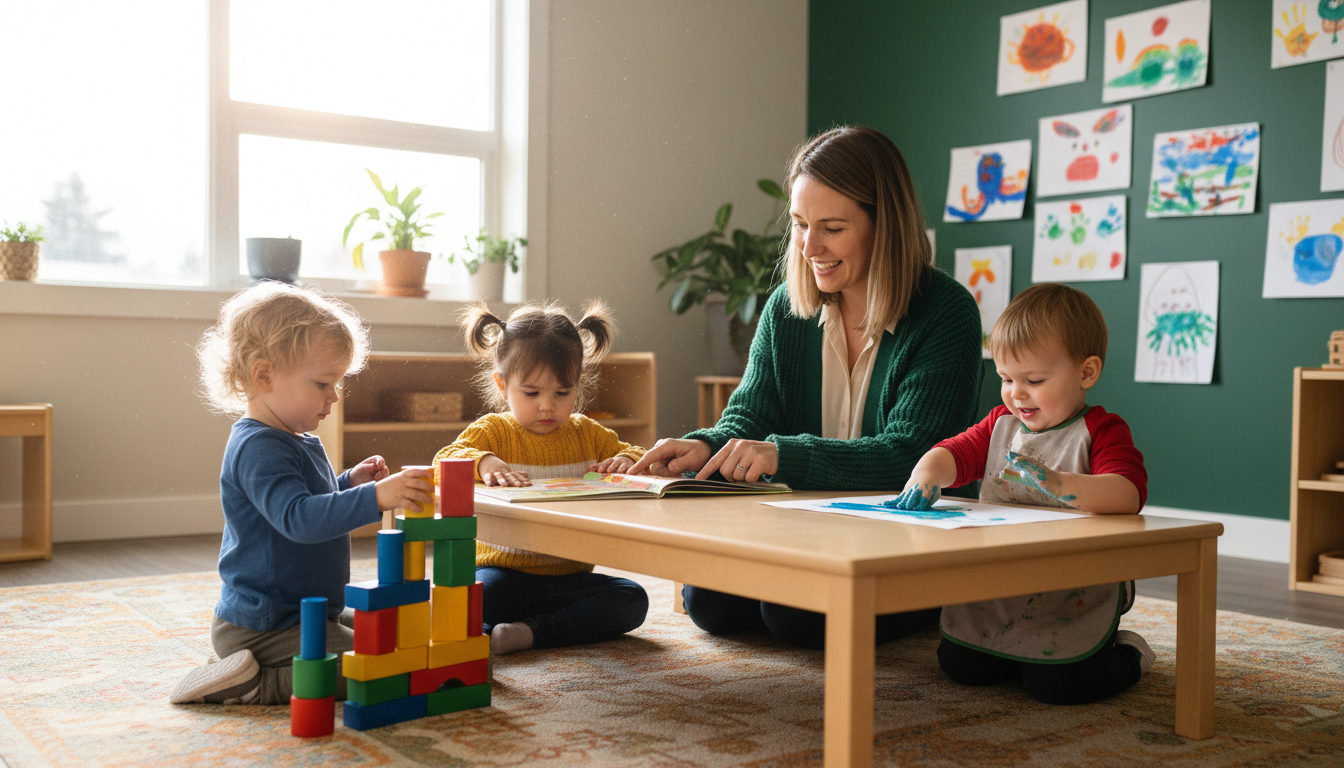


Play-based learning is not a curriculum trend or marketing phrase — it is the scientific consensus on how young children’s brains actually learn. For children from birth to 36 months, play is the primary mechanism through which cognitive, linguistic, social, emotional, and physical development occurs. A daycare that says it uses play-based learning and a daycare that genuinely implements it as its pedagogical foundation look very different. This guide explains what play-based learning actually means in infant-toddler care, why it works, and how it is implemented at Smiling Kids Childcare Centre in Coquitlam. For our full programme guide: daycare Coquitlam — complete parent guide. For our infant-specific programme: infant daycare Coquitlam.
What Play-Based Learning Actually Means — Beyond the Buzzword
The BC Early Learning Framework — BC’s provincial curriculum document for early childhood settings — places play at the centre of learning for all children from birth to age 8. This is grounded in decades of developmental science showing that the brain learns most efficiently when it is intrinsically motivated, actively engaged, and experiencing low stress — conditions that self-directed play naturally creates.
Play-based learning in a quality infant-toddler daycare means:
Child-Initiated vs Adult-Directed Activity
True play-based learning prioritises child-initiated activity over adult-directed instruction. In a toddler room, this looks like: an educator setting out 4–6 “invitations to play” — deliberate arrangements of open-ended materials — and then children choosing where to go and what to do. The educator’s role is to observe, narrate, extend, and document — not to lead the activity toward a predetermined outcome. Compare this to adult-directed “crafts” where every child makes the same thing: in adult-directed activities, adults do the thinking. In child-led play, children do the thinking.
Open-Ended Materials
Play-based learning environments use open-ended materials — things that can be used in multiple ways and have no single correct outcome. Blocks, loose parts (natural objects: pine cones, stones, shells, sticks), playdough, water, sand, clay, art materials, fabric, and cardboard are the workhorses of quality play-based programmes. These materials engage the brain more deeply than single-purpose plastic toys because they require children to imagine, invent, experiment, and problem-solve.
Following the Child’s Lead
A key principle of play-based learning is following the child’s interest and curiosity rather than a predetermined theme or lesson plan. When a toddler at Smiling Kids becomes fascinated with ramps and rolling objects, their primary educator responds by enriching the environment with more ramp-building materials, books about motion, and conversations about speed and gravity — at a developmentally appropriate level. This “emergent curriculum” approach produces deeper learning because it is intrinsically motivated.
How Play-Based Learning Works for Infants (0–18 Months)
Many parents think of play-based learning as something that begins once children can talk or walk. In fact, play-based approaches are fundamental from birth:
- Newborn-3 months: Face-to-face interaction (the foundation of social development), tracking moving objects with eyes (visual attention), hand-to-mouth and hand-to-face exploration, responses to sound and voice
- 3–6 months: Reaching, grasping, and mouthing objects; cause-and-effect play (battering a rattle, kicking a toy that makes noise); social games (peek-a-boo rudiments, vocal exchange)
- 6–9 months: Object exploration (banging, transferring, dropping); early imitation; crawling-based locomotor exploration; stranger awareness and preference for familiar people
- 9–12 months: Object permanence games (finding hidden objects); intentional communication through gesture and vocalisation; first words emerging; joint attention (sharing focus on an object with a caregiver)
- 12–18 months: Symbolic play beginning (using objects to represent other things); language explosion; social referencing (checking caregiver’s reaction before acting); early parallel play with peers
At Smiling Kids, our infant programme supports all of these developmental play stages through intentional, responsive, low-ratio caregiving — not through adult-led “activities” imposed on babies, but through responsive play facilitated by ITE-credentialed educators who understand developmental sequences.
How Play-Based Learning Works for Toddlers (18–36 Months)
Toddlerhood is when play-based learning becomes most visually dramatic. Toddlers at Smiling Kids engage in:
- Construction play: Blocks, Duplo, cardboard tubes, and loose parts for building, knocking down, and rebuilding — developing spatial reasoning, cause-and-effect understanding, and persistence
- Sensory play: Water tables, sand trays, playdough, cooked pasta, slime, cloud dough — engaging the sensory nervous system while developing fine motor skills and scientific thinking (what happens when I mix these? What does this feel like?)
- Dramatic play: Kitchen and household items, dolls, puppets, simple dress-up — the foundation of theory of mind (understanding that other people have thoughts and feelings), language development, and narrative thinking
- Art and mark-making: Crayons, paint, stamps, drawing with sticks in sand — developing fine motor skills and symbolic representation (that a mark can stand for something)
- Physical/gross motor play: Climbing, running, ball play, dancing, obstacle courses — developing coordination, spatial awareness, and self-regulation through the body
What to Ask a Daycare About Play-Based Learning
When touring Coquitlam daycares that claim to use play-based learning, ask:
- Can you walk me through what the room setup will look like tomorrow morning when children arrive?
- Do you use a preset curriculum or emergent/responsive curriculum? Who decides what children do?
- What percentage of children’s time is adult-directed vs child-initiated?
- How do you document children’s learning through play?
- Do educators interrupt play to run “activities,” or do activities emerge from what children are already doing?
Related Reading