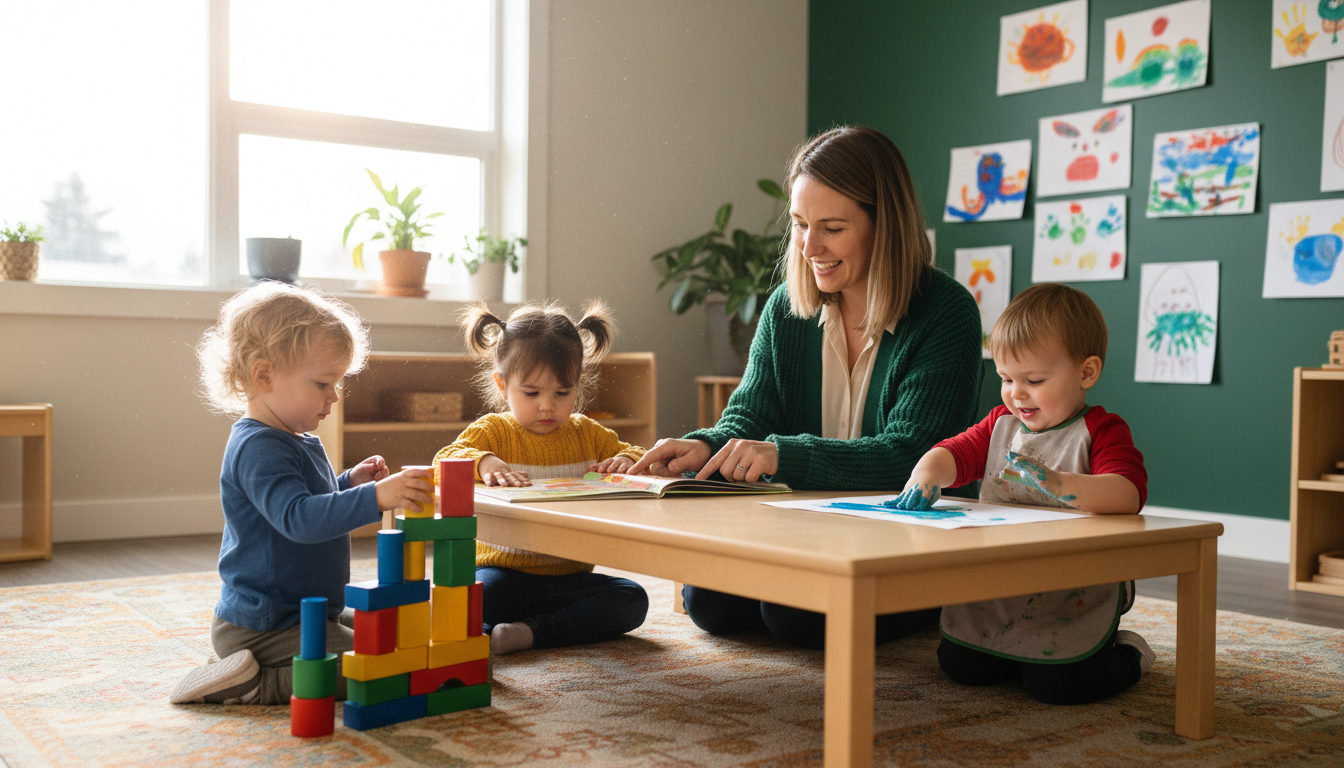


What does “good caregiving” actually do for a baby’s brain? The science of infant brain development has advanced dramatically in the past two decades, and the findings are both exciting and clarifying for parents evaluating licensed childcare: the quality of caregiver interactions — not the toys, the programs, or the facilities — is the single most powerful predictor of infant brain development in group care settings.
For information on BC childcare subsidies and licensed daycare regulations, visit the Government of BC Childcare Resources. Smiling Kids Childcare Centre is a licensed childcare facility meeting all BC childcare regulations.
The Developing Infant Brain: What Caregivers Are Actually Working With
At birth, a baby has approximately 100 billion neurons — roughly the same number as an adult brain. What the infant brain lacks is connections between those neurons. Neural connections (synapses) are formed through experience — specifically through the back-and-forth interactions between the baby and their environment, especially their caregivers.
In the first year of life, the brain forms over 1 million new synaptic connections per second. By age 3, the brain has reached approximately 80% of its adult size and has formed most of the foundational neural architecture it will use for the rest of life. The experiences that drive this development are largely relational — not stimulation-based in the toy-and-activity sense.
Serve and Return: The Core Mechanism
Harvard’s Center on the Developing Child describes the primary mechanism of early brain development as “serve and return”: a baby initiates an interaction (a coo, a reach, a gaze), and the caregiver returns it (a response, a smile, a word). This exchange is repeated thousands of times each day, and each repetition strengthens the neural pathways associated with language, social cognition, and emotional regulation.
When serve-and-return interactions are consistently absent — when babies’ bids for connection are regularly ignored or met with flat, unresponsive behavior — the developing stress-response system activates, and the neural architecture associated with secure attachment and emotional regulation is compromised.
This is why caregiver quality in infant care is so much more important than any specific curriculum, program structure, or facility feature.
What Quality Infant Caregivers Do Differently
In a licensed infant care setting, here is what the research identifies as high-impact caregiver behaviors:
Narration of Routines
High-quality caregivers narrate everything: “I’m going to pick you up now,” “Let’s get your diaper changed,” “You’re looking at the window — that’s the sunlight!” This narration builds vocabulary, supports language development, and creates predictability that reduces stress for the baby.
Responsive Reading of Cues
Expert infant caregivers read each baby’s unique cue language: which cry means hungry vs. tired vs. overstimulated, which body posture signals a need for movement vs. settling, which facial expression signals interest vs. overwhelm. This attunement — built over weeks of consistent caregiving — allows precise, responsive care that reduces frustration and builds secure attachment.
Face-to-Face Engagement
Human faces are, developmentally, the most important stimulus in an infant’s environment. Caregivers who spend time at face level with babies — making eye contact, mimicking expressions, engaging in “conversations” — are directly supporting the social brain, visual processing, and emotional recognition circuits.
Physical Warmth and Touch
Touch is not just comfort — it’s developmental medicine. Studies of infants in institutional care with inadequate physical contact show demonstrable differences in brain development, stress hormone levels, and social functioning. In a quality licensed daycare, holding, carrying, and physical closeness are understood as developmental necessities, not extras.
What This Means for Evaluating Infant Care in Coquitlam
When you tour a licensed daycare in Coquitlam, the things that matter most for brain development are:
- Caregiver ratio and group size: How many babies per caregiver? BC requires 1:4 for infants — look for centres that maintain or exceed this, especially for the youngest babies.
- Caregiver consistency: Does your baby have the same primary caregiver each day? Consistency is the foundation of secure attachment and the prerequisite for serve-and-return to build over time.
- Staff interaction quality: During the tour, watch how caregivers interact with babies present. Are they at face level? Are they narrating? Are they responsive to cues?
- Staff qualifications: RECE certification with Infant/Toddler specialization means the caregiver has formal training in exactly this developmental knowledge. Learn more about why RECE credentials matter in Coquitlam daycare.
Book a tour at Smiling Kids — watch our caregivers with babies firsthand. 604-600-4393.
Related: Baby Milestones 0–3 Months | What Is Play-Based Learning?
At Smiling Kids infant daycare in Coquitlam, our ITE-credentialed educators support every developmental milestone covered in this article — through our primary caregiver model and responsive, individualised care for babies 0–18 months. For our complete daycare guide including programmes, costs, and enrollment: daycare in Coquitlam.