

Parents of toddlers in 2026 are increasingly being marketed to by “academic preschool” programs claiming that structured reading, numeracy, and language instruction starting at age 2 creates better outcomes than play-based approaches. This article examines what the research actually says — and why the scientific consensus strongly favours play-based learning for children under 3.
For information on BC childcare subsidies and licensed daycare regulations, visit the Government of BC Childcare Resources. Smiling Kids Childcare Centre is a licensed childcare facility meeting all BC childcare regulations.
What Do We Mean by “Play-Based” vs “Academic”?
These terms are often used loosely, so it’s worth defining them clearly:
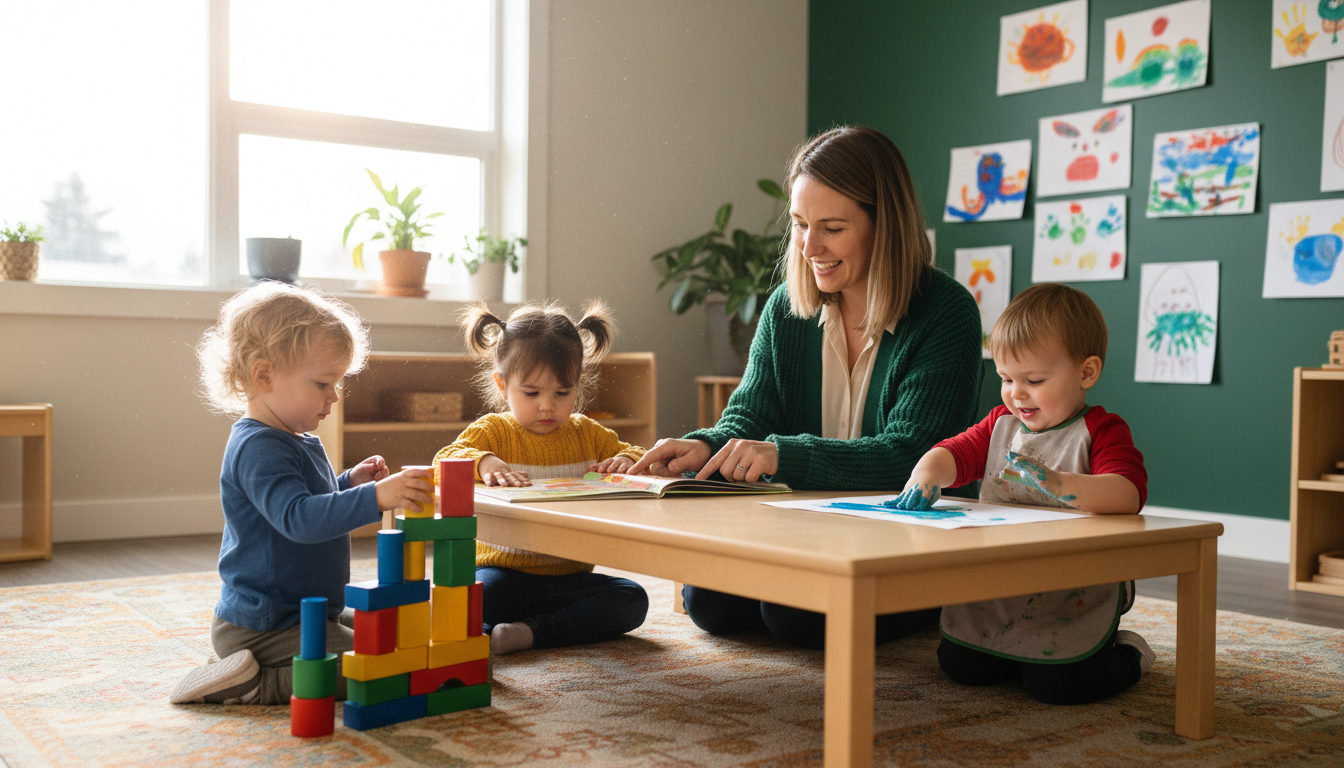
- Play-based learning is an approach where children’s self-directed play is the primary vehicle for learning. Educators observe, support, and extend children’s play rather than directing specific activities. The environment is prepared to invite exploration, but the child drives the learning. This is the approach used in most licensed childcare and most research-supported early childhood programs.
- Structured academic programs use direct instruction methods — circle time lessons, worksheets, structured literacy and numeracy exercises — typically modelled on early elementary school pedagogy but applied to children as young as 2 or 3.
What Does the Research Say?
Short-Term Gains That Don’t Last
The research on structured academic programs for children under 5 consistently finds the same pattern: children in academic programs show slightly higher test scores in specific skills (letter recognition, number identification) in kindergarten. But these advantages disappear by Grade 1 or 2, after which children from play-based programs perform at the same level or better.
A landmark study by Adele Diamond and colleagues found that executive function — the ability to focus, plan, regulate impulses, and switch between tasks — is a better predictor of school success than early academic content knowledge. And executive function is developed through play, not instruction.
Long-Term Harms of Over-Structured Early Programs
Several longitudinal studies have found concerning long-term effects of highly structured academic programs for very young children:
- Higher rates of anxiety and behavioral problems by middle childhood
- Lower intrinsic motivation and creativity
- Reduced enjoyment of learning and school
- No lasting academic advantage
The most famous of these is the Perry Preschool Study, which followed children into adulthood and found that a play-based approach produced better life outcomes (employment, health, civic participation) than a structured academic comparison group — even though the academic group showed higher test scores in the early years.
Why Play Is the Developmentally Correct Method for Under-3s
The reason play-based approaches work better for children under 3 isn’t ideology — it’s developmental biology. The prefrontal cortex, which handles abstract reasoning, following instructions, and sustained attention, is the last brain region to develop. It isn’t functional in ways that support structured academic learning until approximately age 4–5 for most children, and continues developing into the mid-twenties.
Before that developmental milestone, children learn best through:
- Hands-on sensory experience
- Relational interactions with responsive caregivers
- Self-directed exploration in prepared environments
- Repetition through play (not drills)
Trying to teach a 2-year-old to read through structured instruction doesn’t just fail to produce early readers — it crowds out the play experiences that build the foundational skills (language, executive function, social competence) that actually predict reading success.
What This Means for Choosing a Daycare in Coquitlam
When evaluating licensed childcare centres in Coquitlam, look for:
- A prepared environment — rich in materials, open-ended activities, and sensory exploration opportunities
- Educator observation — staff who watch, listen, and respond to children’s play rather than directing it
- Documentation practices — daily notes that describe what the child was exploring and how they engaged, not just “what we taught today”
- Developmentally appropriate expectations — a centre that respects 18-month-old developmental realities rather than trying to advance them artificially
Watch out for centres that:
- Advertise academic curricula for under-3s
- Show worksheets or structured “lessons” for infants or young toddlers
- Emphasize “learning outcomes” over play and relationship
- Have rigid schedules that don’t accommodate individual children’s needs
At Smiling Kids: Play-Based Learning in Practice
At Smiling Kids Childcare Centre in Coquitlam, our curriculum follows BC’s Early Learning Framework and is grounded in play-based learning research. Our educators hold RECE certifications with Infant/Toddler specialization and are trained in developmental observation and documentation. We don’t do worksheets. We don’t do structured academic lessons. We do prepare rich environments, maintain warm responsive relationships with every child, and support the play that builds the foundation for everything that comes next.
Book a tour to see our play-based approach in action — 604-600-4393.
Also see: What Is Play-Based Learning? A Parent’s Complete Guide.
🔗 Related Resources for Coquitlam Families
- Licensed Daycare Coquitlam — Smiling Kids Childcare Centre
- Infant Daycare Coquitlam (4–18 Months)
- BC Childcare Subsidy Coquitlam: CCFRI + ACCB Explained
- How Much Does Daycare Cost in Coquitlam? 2026 Figures
- Childcare in Coquitlam BC — What Parents Need to Know
Book a tour at Smiling Kids: 604-600-4393 | Contact Us