

The 24–36 month window — the final year of toddlerhood before a child is considered preschool age — is marked by remarkable cognitive and linguistic leaps. Symbolic play emerges fully, language becomes syntactically sophisticated, and self-help skills develop rapidly. For Coquitlam parents with toddlers in this range, here is what the research and practice show about what to expect.
Language Milestones: 24–36 Months
Vocabulary and Sentence Complexity
- 24 months: 50–200+ words, beginning two-word combinations, using language for requests and protests
- 30 months: 300–500+ words for many children; three-word phrases (“daddy go work,” “me want more”); beginning to ask “what” and “where” questions
- 36 months: Full sentences of 4–5+ words; uses “I,” “you,” and “me” (though still sometimes confused); asks “why” questions; can tell simple stories about recent events
The range at this age is enormous. Some 3-year-olds speak in long, grammatically sophisticated sentences; others are at 3-word phrases. Both can be within the normal range — context matters enormously. If a 3-year-old is not using sentences of at least 3 words, speech-language evaluation is warranted.
Intelligibility
By 24 months, family members (who know the child) should understand roughly 50% of what the child says. By 36 months, strangers should understand about 75% of what the child says. Significantly below these benchmarks warrants speech-language referral.
Cognitive Milestones: 24–36 Months
Symbolic and Pretend Play
One of the most developmentally significant milestones of this period is the full emergence of symbolic play — pretending a banana is a phone, feeding a doll, acting out a familiar scene (bedtime, making breakfast). Symbolic play requires the child to hold two realities simultaneously: “this IS a banana” and “I’m using it AS a phone.” This dual representation is also the cognitive foundation of literacy (a letter IS a squiggle AND it represents a sound).
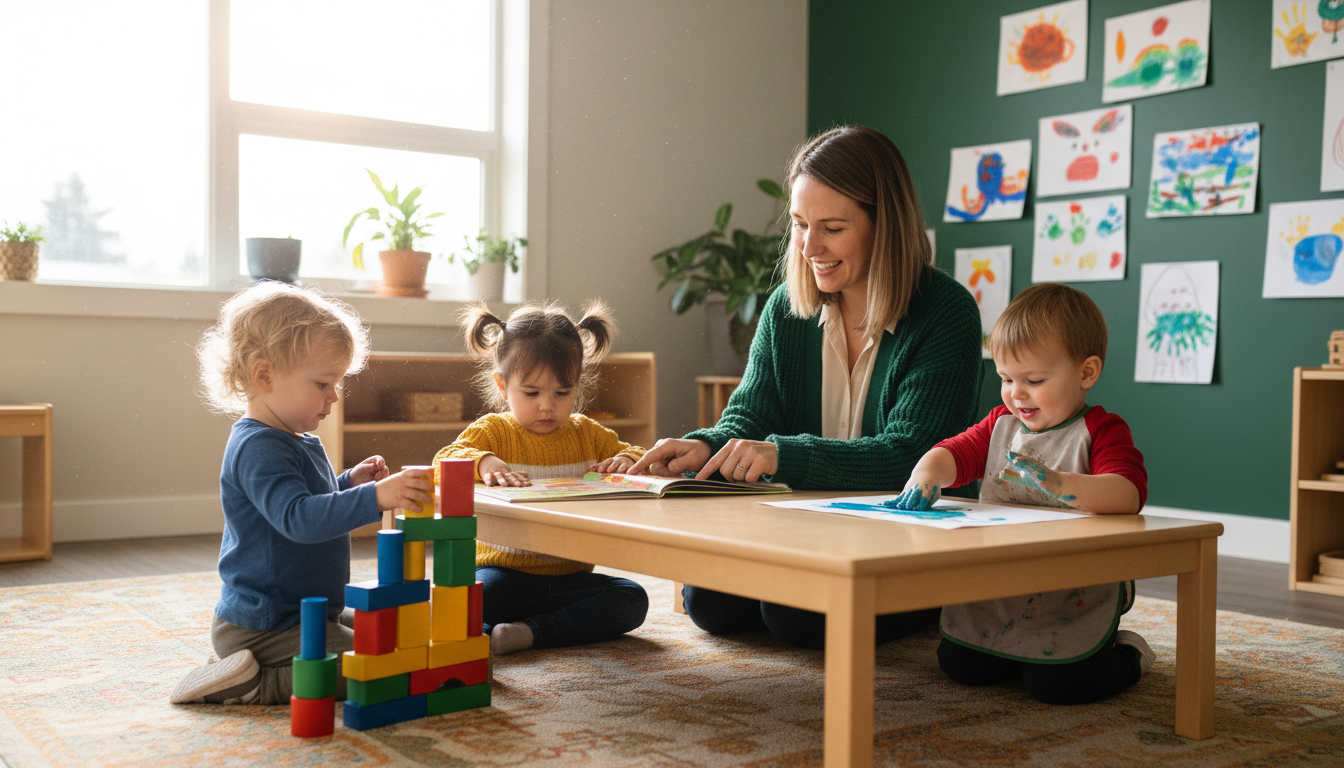
Pretend play in group care benefits enormously from peers — the dramatic play that emerges when two or three toddlers begin coordinating a pretend scenario (“you be the baby and I’ll be the mama”) is one of the richest social-cognitive experiences available at this age.
Memory and Narrative
By 30–36 months, most toddlers can narrate recent events: “We went to grandma’s house and there was a dog and it was big and it scared me.” This autobiographical memory and narrative ability is a crucial developmental achievement — it’s the beginning of the child understanding themselves as a person with a past, present, and future.
Early Numeracy Concepts
By 36 months, many children can count objects to 5 (or beyond), understand “more” and “less” in concrete comparisons, and sort by color and shape. These are not school-taught skills — they emerge naturally from play-based experiences with manipulatives, building, and organized environments.
Physical Milestones: 24–36 Months
- 24 months: Running fairly smoothly; jumping (both feet leave the ground); kicking a large ball
- 30 months: Jumping off low surfaces; beginning to climb playground equipment; beginning to pedal a tricycle
- 36 months: Running with adult-like coordination; hopping on one foot (some children); drawing a circle; using scissors with assistance
Self-Help Milestones: 24–36 Months
The 24–36 month range is prime time for self-help skill development — the toddler is developmentally driven to “do it myself.”
- Using a spoon fairly reliably by 24 months; fork emerging
- Beginning to undress (pulling off socks, unzipping) by 24 months
- Pulling pants up and down by 30 months (relevant for toilet training)
- Washing hands with prompting by 30 months
- Beginning to put on simple clothing independently by 36 months
At Smiling Kids, we support self-help skill development by giving children time and space to do things themselves — even when it takes longer than doing it for them. This patience is developmentally important, not inefficiency.
Supporting Your 24–36 Month Old at Daycare
For toddlers in this range at Smiling Kids Coquitlam, our program provides:
- Rich pretend play environments with props and dress-up materials
- Language stimulation through conversation, books, and narration
- Outdoor physical challenges: climbing, running, and balancing opportunities
- Self-help routines: children participate in setting up and cleaning up, handwashing, dressing for outdoor play
- Small group dramatic play facilitation
Questions about our program for 2-year-olds? 604-600-4393.
Smiling Kids provides ITE-credentialed infant daycare in Coquitlam for babies 0–18 months — primary caregiver model, responsive care, CCFRI participating. Complete daycare guide: daycare Coquitlam.