

Reading aloud to babies — even very young babies who cannot yet understand words — is one of the highest-impact, lowest-cost developmental activities available. The evidence is extensive, and the mechanism is clear: books and storytime create the language-rich interaction experiences that build vocabulary, phonological awareness, and the love of reading that underlies lifelong literacy. Here is what the research shows and what quality infant programs in Coquitlam do with it.
Why Reading to Babies (Even Newborns) Matters
Babies cannot understand words for months after birth. So why read to a newborn? Because the benefit of early reading isn't about comprehension — it's about exposure to:
- Language rhythm and prosody: The melodic patterns of spoken language, which the brain learns to recognize and eventually decode into meaning
- Vocabulary breadth: Books use a wider range of vocabulary than everyday conversation, exposing babies to words they'd never hear in typical caregiving routines
- Face-to-face attention: Reading together creates face-to-face, eye-contact-rich interactions that stimulate social brain development
- Shared attention: Learning to attend to the same object (a book) with a caregiver is a fundamental joint attention skill
- The pleasurable association: Babies who are read to from birth associate books with warmth, closeness, and positive interaction — a foundation for the motivation to read later
What Babies Get From Storytime at Each Stage
0–3 Months: Sound and Face
At this stage, books are primarily about the caregiver's voice and face. High-contrast black-and-white board books with simple patterns hold visual attention briefly. What matters most is the caregiver's vocal responsiveness — the singing quality of the narration, the pauses, the eye contact. The content of the words is secondary to the sound and interaction.
4–6 Months: Beginning Visual Attention
By 4–6 months, babies can track illustrations and show clear interest in particular images. Simple, bold, colorful illustrations hold attention longer. Point-and-name (“dog!” + pointing) begins to work: the baby looks at your finger, then the object. This is the beginning of joint visual attention to books.
7–12 Months: Active Participation
Mobile babies engage with books physically — reaching for them, mouthing board book corners (normal; board books exist for this reason), pointing at images, vocalizing in response to familiar phrases. Repetitive books with predictable refrains (“Brown Bear, Brown Bear, what do you see?”) become favorites because the baby begins to anticipate the pattern. This anticipation is cognitive processing of narrative structure — the foundation of story comprehension.
12–24 Months: Naming, Pointing, Simple Narrative
Toddlers in this range actively participate in shared reading: pointing to named objects (“where's the cat?”), filling in repeated phrases, turning pages purposefully. Vocabulary from books they hear repeatedly begins appearing in the child's own speech — words like “enormous” or “puddle” that they'd never encounter in everyday conversation.
How Storytime Is Done at Smiling Kids
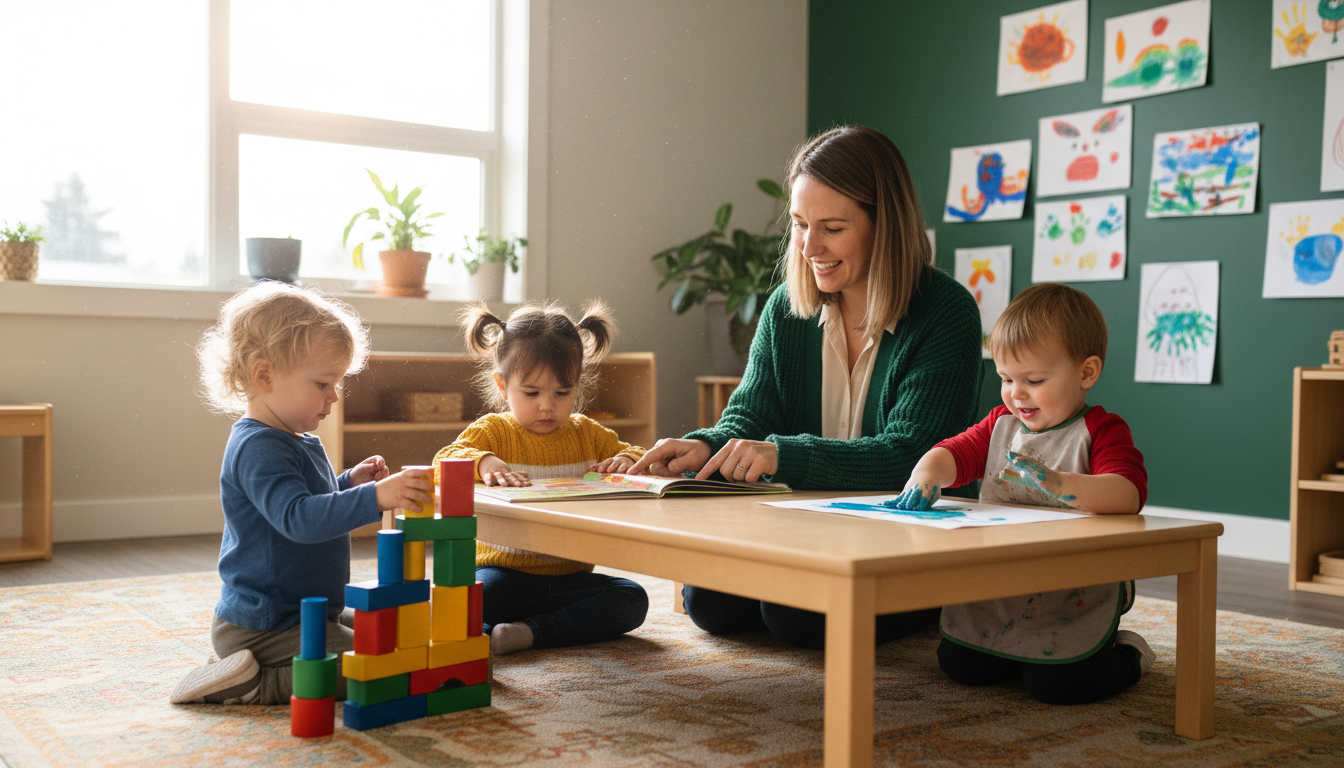
At Smiling Kids Childcare in Coquitlam, books are woven through the day — not limited to a single “storytime” block:
- Small-group read-alouds with discussion and interaction
- Book corners accessible throughout the day for self-directed browsing
- Educators who narrate illustrations and pause for child response
- Board books and cloth books in the infant area for mouthing-safe exploration
- Seasonal and culturally diverse book selections throughout the year
- Books reflecting the cultural backgrounds of enrolled families where possible
Book a tour to see our reading environment in action — 604-600-4393.
Also see: Toddler Language Development at Daycare.
How Storytime at Licensed Daycare Accelerates Language Development
Books at licensed daycare are not just entertainment — they are one of the most research-supported language development tools available to educators working with the 0–3 age group. At Smiling Kids Childcare Centre in North Coquitlam, daily storytime is a structured part of the curriculum for both infants and toddlers, with books selected to match each room’s developmental stage.
Shared book reading produces vocabulary exposure at a density and richness that spontaneous play-based conversation rarely achieves. Picture books use words that parents and educators do not typically use in everyday speech — words like “enormous,” “shimmering,” “grateful” — and hearing them in context, with a picture to anchor the meaning, is how children acquire vocabulary that would otherwise arrive much later.
Best Books for Infants at Daycare (0–12 months)
- High-contrast images and simple faces: Infants at 0–3 months respond most to high-contrast black-and-white patterns and human faces — their visual system is not yet developed enough for complex colour scenes
- Board books with one image per page: Simple, uncluttered pages allow an infant to focus without cognitive overload
- Familiar objects: Books about faces, animals, and household objects build object permanence and vocabulary simultaneously
- Rhyme and rhythm: Even infants who cannot understand words respond to the prosody of rhyme — the musicality of language builds auditory foundations for later reading
Best Books for Toddlers at Group Daycare (12–36 months)
- Predictable, repetitive text: Toddlers in the 18–24 month range love books they can “read along” with — predicting the next word builds phonological awareness
- Emotion-focused stories: Books that name and explore emotions give toddlers language for their inner experience — essential for emotional regulation development
- Books that invite participation: Lift-the-flap, touch-and-feel, and call-and-response books keep toddlers engaged in group settings longer than passive picture books
- Stories with diverse characters: Children who see themselves in books develop stronger reading identity; children who see others develop empathy
Extending Daycare Storytime at Home
Ask your child’s Smiling Kids educator which books they are reading this week — reading the same book at home reinforces vocabulary exposure from both environments. The more times a child encounters a new word in different contexts, the more deeply it embeds. 1380 Coast Meridian Rd, Coquitlam. 604-600-4393.
Smiling Kids provides ITE-credentialed infant daycare in Coquitlam for babies 0–18 months — primary caregiver model, responsive care, CCFRI participating. Complete daycare guide: daycare Coquitlam.