

Block play is the foundation of early STEM learning — and one of the most developmentally rich activities available to babies and toddlers. Long before a child can understand mathematics or engineering concepts formally, they are building their intuitive understanding of physics, geometry, spatial reasoning, and cause-and-effect through unit blocks, foam blocks, and loose construction materials. Here's what the research shows and what quality licensed daycares do with it.
What Babies and Toddlers Learn Through Block Play
Physics and Engineering (Intuitively)
Every time a toddler stacks blocks and they fall, or tries to balance a long block on a short one, or discovers that knocking one block sends another flying, they are doing experimental physics. They're testing hypotheses, observing outcomes, and — over hundreds of repetitions — building intuitive models of how physical forces work. This is the exact same cognitive process that underlies formal scientific reasoning; it just looks like play.
Spatial Reasoning
Spatial reasoning — the ability to mentally rotate objects, understand three-dimensional relationships, and visualize how shapes fit together — is one of the strongest predictors of later STEM performance. Block play is one of the few early childhood activities that directly and powerfully builds spatial reasoning, because it requires physically manipulating three-dimensional objects and developing mental representations of their spatial relationships.
Mathematical Concepts
- Number and quantity: “I need more blocks.” “You have more blocks than me.” Early numeracy concepts emerge naturally through block play.
- Geometry: Rectangles, squares, triangles, cylinders — children learn shape names and properties through direct manipulation far more effectively than through worksheets.
- Measurement: “This tower is taller than that one.” “Two small blocks are the same length as one big block.” Early measurement concepts through physical comparison.
- Symmetry and pattern: Children spontaneously create symmetric block structures and patterns from around 2 years — building visual-mathematical thinking.
Problem-Solving and Persistence
Building with blocks is inherently problem-solving: how do I make this taller without it falling? How do I create an arch? How do I balance this piece here? The frustration of structures falling and the satisfaction of a successful build provide natural motivation for persistence — a critical non-cognitive skill for school and life success.
Block Play by Developmental Stage
6–12 Months: Mouthing and Banging
Infants at this stage explore blocks primarily through mouths and hands: mouthing, banging, dropping, and stacking (briefly). The value is sensory exploration and beginning cause-and-effect understanding. Soft foam blocks that are safe for mouthing are appropriate at this stage.
12–18 Months: Stacking and Knocking Down
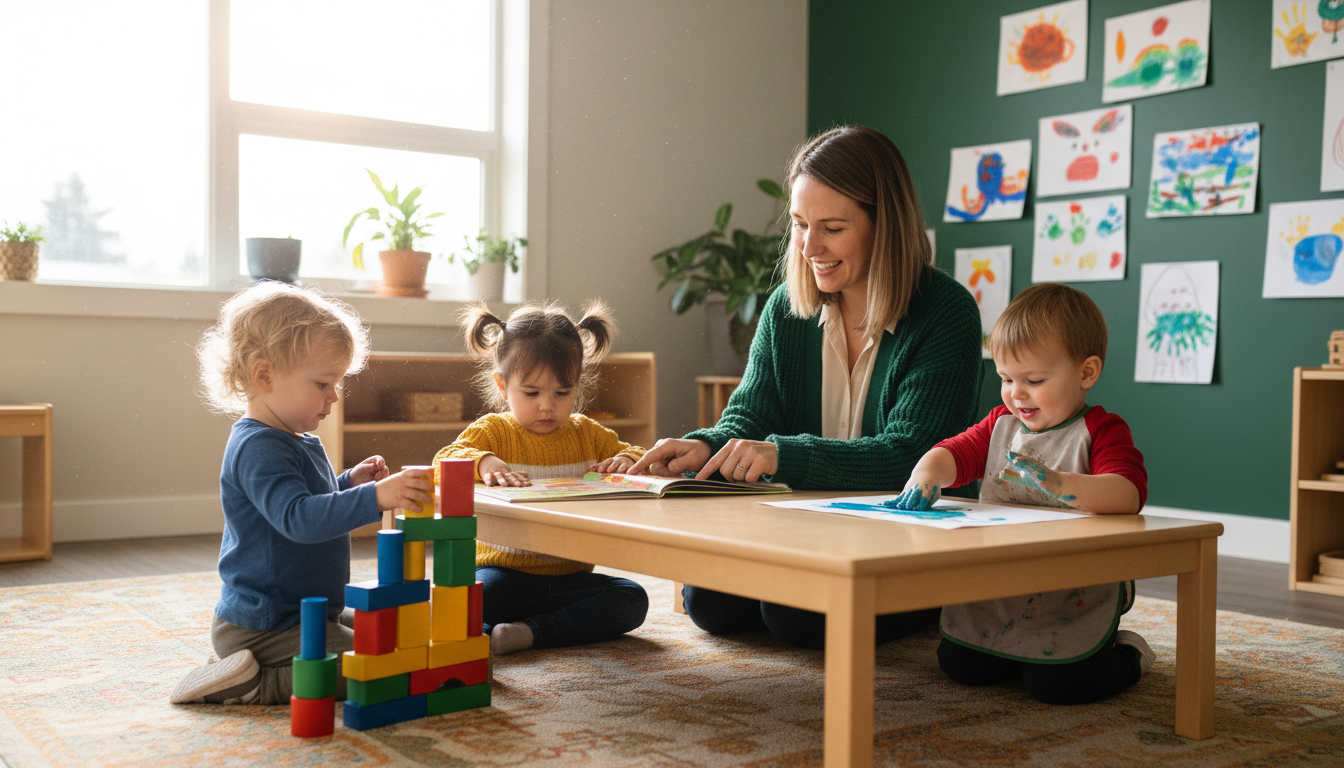
The developmental joy of stacking and knocking down is at its peak in this window. The child is testing gravity, cause-and-effect, and their own ability to create and destroy. Knocking is not destructive play — it's experimental physics. Stack-and-knock play typically reaches 2–4 blocks by 18 months.
18–24 Months: Simple Structures
Toddlers in this range begin making simple enclosures (a square of blocks as a “house”) and simple roads and bridges. Symbolic play begins to combine with construction: “this is a tower for the animals.” Unit blocks work well at this stage.
24–36 Months: Complex Structures and Symbolic Play Integration
By 2.5–3 years, block structures become increasingly sophisticated, and dramatic play is richly integrated: “this is the castle and the people live here and there's a bridge and the river is over there.” Towers reach 6–10 blocks. Structures become increasingly symmetric and elaborated.
Block Play at Smiling Kids Coquitlam
Our block area is a core feature of both our infant and toddler environments — stocked with age-appropriate materials (soft blocks for infants, unit blocks for toddlers) and available daily for child-led exploration. Book a tour — 604-600-4393.
Why Block Play Is One of the Most Valuable STEM Activities at Daycare
Unit blocks — the classic rectangular wooden blocks found in quality licensed daycares — are consistently rated by early childhood researchers as one of the highest-value learning materials available to the 0–3 age group. Understanding what block play actually builds helps Coquitlam parents see a child apparently “just playing with blocks” as engaged in sophisticated learning work.
What Block Play Develops in Babies (6–18 months)
- Object permanence: Knocking a tower down and watching it reappear when rebuilt — the object continues to exist even when not visible. This is the cognitive foundation for all future problem-solving.
- Cause and effect: “I knock it, it falls. Every time.” This reliable cause-effect relationship is one of the earliest forms of scientific thinking — repeatability, prediction, and outcome verification
- Gross motor coordination: Reaching, stacking, grasping, and placing blocks build hand-eye coordination and fine motor precision simultaneously
- Spatial reasoning (early): Even simple stacking requires spatial orientation — which block goes on top, which ones create a stable base — laying early foundations for later geometry and physics intuition
What Block Play Develops in Toddlers (18–36 months)
- Spatial reasoning (advanced): Intentional structure building — a house, a garage, a tower — requires mental rotation, spatial planning, and 3D thinking
- Mathematical thinking: Sorting by size, building symmetrical structures, understanding that two short blocks equal one long block — all early mathematical concepts embedded in play
- Problem-solving and persistence: A tower falls 7 times before it stands. The toddler who keeps trying without adult prompt is building executive function and growth mindset simultaneously
- Symbolic play and narrative: “The block is a car” — this abstraction (one thing stands for another) is the cognitive prerequisite for language, reading, and all symbolic thought
Block Play at Smiling Kids Childcare Centre
The Smiling Kids infant and toddler environments include age-appropriate block collections — soft blocks for younger infants, unit blocks for toddlers. Block play is unstructured and child-led: educators do not direct what gets built. They observe, narrate (“You made it so tall!”), and support without redirecting the child’s creative intention. 1380 Coast Meridian Rd, Coquitlam. 604-600-4393.
Smiling Kids offers licensed toddler daycare in Coquitlam BC for children 18–36 months — play-based, ITE-certified, CCFRI participating (~$10/day). Complete daycare guide: daycare Coquitlam.