

What do BC licensed daycares think about screen time? In short: the research is clear, BC licensing guidelines align with it, and quality infant and toddler programs keep screens out of the room. Here is what the evidence says, what BC recommends, and what Smiling Kids does specifically.
Health Canada and BC Screen Time Guidelines for Under-3
Health Canada and the Canadian Paediatric Society are unambiguous on screen time for young children:
- Under 2 years: No screen time recommended, with the sole exception of video-calling (FaceTime, Zoom) with family members.
- 2–5 years: No more than 1 hour per day of high-quality programming (e.g., educational shows) with adult co-viewing.
These recommendations apply to all settings — home and childcare. BC’s Early Learning Framework is consistent with this, emphasizing that screens are not an appropriate replacement for the responsive human interaction that drives early development.
What BC Licensing Requires of Licensed Daycares
BC’s Child Care Licensing Regulation does not enumerate a specific daily screen time limit, but:
- Centres are required to follow their documented program plan, which must align with BC’s Early Learning Framework
- Fraser Health inspectors may question the use of screens as a routine programming tool during inspections
- Centres whose program plans do not adequately address developmental programming can be flagged in inspection reports
In practice, a licensed infant room that uses a TV as a pacifier or routine entertainment is operating below the spirit of BC licensing requirements, even if it does not trigger a formal deficiency citation.
Why Screens Are Counterproductive for Babies Under 18 Months
The research on early screen exposure is extensive. Key findings for infant-focused parents:
- Language development: Infants learn language from live human interaction — from reading conversational cues, turn-taking, and social contingency. Screens cannot provide this.
- Attention systems: Fast-paced screen content can interfere with the development of sustained attention in infants and toddlers.
- Sleep: Screen light before nap time is associated with shorter, lighter sleep in infants.
- Missed interaction: Time spent watching a screen is time not spent engaging with educators and peers — the actual driver of development at this age.
What Smiling Kids Does Instead of Screens
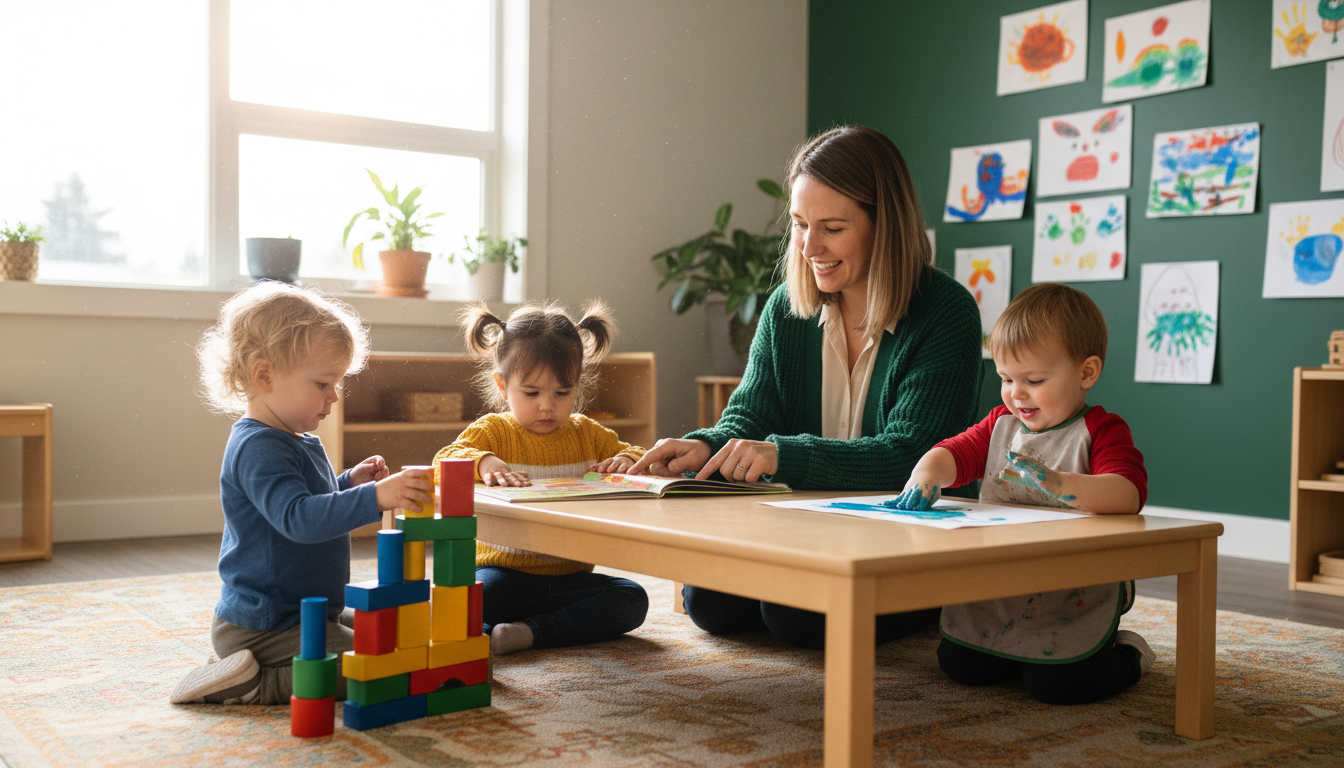
At Smiling Kids, screen-based programming is not part of our infant or toddler program. Instead:
- Language-rich educator narration throughout all routines
- Books and oral storytelling during quiet times
- Music (live singing, recorded music without video) for sensory engagement and transition support
- Sensory play, art, blocks, and movement activities
- Outdoor play as the preferred alternative to any form of passive indoor entertainment
Questions to Ask on a Daycare Tour About Screen Time
- Do you use screens or tablets as part of your program?
- What is your policy on screen time for infants (under 2)?
- How do educators manage transitions or settling-down periods without screens?
A hesitant or vague answer to these questions is worth noting.
Smiling Kids Childcare Centre — North Coquitlam
We are a Fraser Health licensed infant and toddler program at 1380 Coast Meridian Road, North Coquitlam, BC V3E 0E9. To book a tour: 604-600-4393 | Mon–Fri 7:00 AM–6:00 PM
Screen-Free Daycare: What the Research Says and What It Means for Coquitlam Families
BC’s Child Care Licensing Regulation prohibits the use of screens for entertainment in licensed daycare for children under 5 except in limited, specified educational contexts. Smiling Kids Childcare Centre maintains a screen-free environment for all infant and toddler programming — and the research behind this policy is compelling.
Why Screens Are Problematic for the 0–3 Age Group
- Language development: Language is acquired through contingent, face-to-face interaction — a real person who responds to the child’s communication in real time. Screens produce non-contingent language input — the cartoon character cannot respond to what the baby just said. This structural difference means that screen time does not contribute to language acquisition and may displace time that would have been spent in responsive interaction
- Attention development: Screen media — especially fast-paced, highly stimulating content — trains the attention system toward rapid external stimulation. The research suggests this makes extended attention to slower, less stimulating activities (books, play, conversation) harder to sustain
- Sleep: Screen use within 60–90 minutes of sleep consistently disrupts sleep onset and reduces total sleep duration in toddlers
- Physical activity displacement: Every minute of screen time is a minute not spent in physical activity — and the toddler physical activity target (180 minutes daily) is already difficult to meet in Canadian winters
What Smiling Kids Does Instead
Every activity that families might use screens for at home has a screen-free equivalent at Smiling Kids:
- Background music vs background TV: curated playlists, instruments, live singing
- Educational videos vs passive watching: hands-on exploration, sensory materials, real books
- Screen-based calming vs regulation: rocking, co-regulation, quiet time in a calm corner
Screen Time at Home: What the Guidelines Say
Canadian Paediatric Society guidelines: no screen time for children under 24 months except video calls with family. Ages 2–5: maximum 1 hour/day of high-quality programming with active co-viewing. The daycare screen-free standard supports families who are following these guidelines at home. 1380 Coast Meridian Rd, Coquitlam. 604-600-4393.
For a complete guide to licensed daycare in Coquitlam — Fraser Health licensing, ECE/ITE credentials, CCFRI subsidies, and enrollment at Smiling Kids — visit our main Coquitlam daycare guide. Licensing details: Fraser Health licensed daycare Coquitlam.