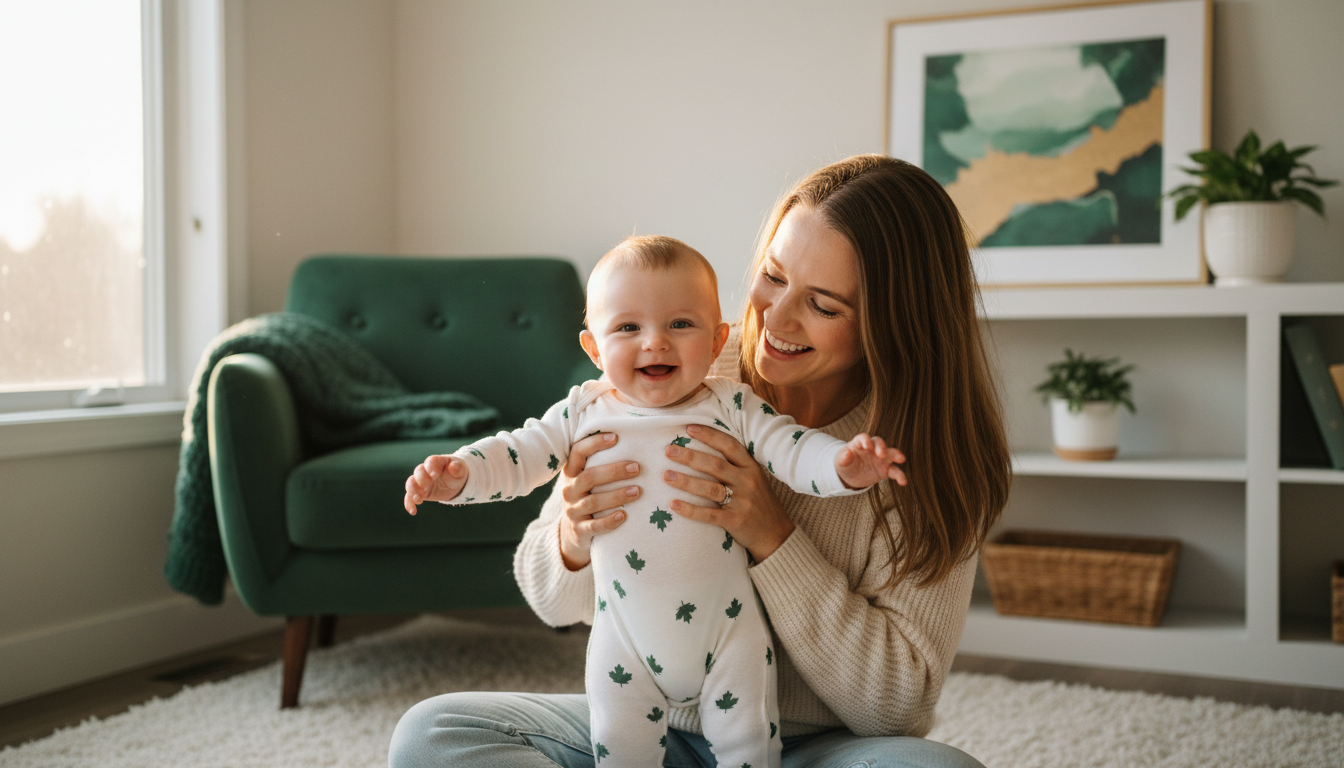


The first birthday is a massive developmental milestone — not just for parents but in real neurological terms. In the 10–12 month period, babies typically add walking (or the skills that lead directly to it), genuine first words, sophisticated problem-solving, and the full flowering of separation protest and social connection. For Coquitlam parents tracking their baby’s development or preparing for infant care, here’s what to expect in this remarkable three-month window.
Motor Milestones: 10–12 Months
Pulling to Stand and Cruising
By 10 months, most babies who haven’t already done so are pulling themselves to stand using furniture, caregiver legs, or any available surface. From standing, cruising — stepping sideways while holding onto furniture — often begins around 10–11 months and is a key precursor to walking.
First Independent Steps
The range for first independent steps is enormous — from as early as 9 months (rare) to as late as 15–16 months (normal). The average is approximately 12 months. Key signs that walking is imminent: standing momentarily without support, attempting to walk between two people or two pieces of furniture, and reducing reliance on furniture for support during cruising.
Note: babies who crawl with an asymmetrical pattern, or who walk early but seem unstable on one side, are worth discussing with a pediatrician — but early vs. late walking within the normal range is not a developmental concern.
Refined Pincer Grasp
By 10–12 months, the pincer grasp (thumb + forefinger) is well established and increasingly precise. Babies can pick up cheerio-sized objects intentionally. This creates both exciting fine motor opportunities (stacking, inserting, manipulating small objects) and safety considerations (small objects on the floor are now accessible).
Feeding Self-Sufficiency Increasing
By 12 months, most babies can feed themselves many finger foods, hold a bottle or sippy cup independently, and are beginning to attempt spoon use. Mealtime becomes more participatory — and messier. This is developmentally appropriate and important to support, not prevent.
Language Milestones: 10–12 Months
First True Words
The most celebrated milestone of this period: first words. Most babies say their first recognizable, intentionally referential word between 10 and 14 months. “First words” means words used consistently to refer to the same thing — “da” said every time the dog appears, “ba” always used when wanting the bottle.
By 12 months, many babies have 1–3 true words; some have more; some have none yet and are still on track. The range is wide.
Comprehension Far Ahead of Production
At 12 months, most babies understand significantly more than they say. They follow simple instructions (“come here,” “give me,” “where’s the dog?”), respond to their name consistently, and understand “no” as a prohibition (even if they don’t always comply with it).
Pointing Emerges
Pointing — both declarative pointing (look at that!) and imperative pointing (I want that!) — is a critical milestone that typically emerges around 9–12 months. It is one of the earliest forms of joint attention: directing another person’s attention to the same thing you’re attending to. This shared attention capacity is a foundation of language, learning, and social cognition. Pointing at 12 months is a developmental milestone worth noting; absence of pointing by 12 months is worth mentioning to a pediatrician.
Social-Emotional: 10–12 Months
- Separation protest peak or plateau: Separation protest, which began escalating around 8–9 months, typically plateaus and then gradually begins declining after 12–14 months as the child develops more robust internal representations of the caregiver
- Social referencing well established: Baby consistently checks caregiver’s face for emotional information in novel situations
- Early humor: Babies at this age begin to laugh at incongruity, play simple jokes (putting a hat on the dog), and initiate “chase” games
- Strong attachment behaviours: Following the caregiver around the room, protesting when left, showing preference for specific people
At Smiling Kids: Supporting the 10–12 Month Developmental Stage
For babies in our infant program during this period, we provide:
- Safe walking opportunities — clear floor space, push toys, safe standing surfaces
- First-word support — responding to all vocalizations as meaningful communication
- Self-feeding support — age-appropriate finger foods, beginning spoon practice
- Consistent caregiver assignments during the separation protest peak
- Documentation of first steps and first words for parents who aren’t present when these happen
Continue the series: Baby Milestones 7–9 Months
Complete milestones series: Baby and toddler milestones BC — full 0–36 month guide.
Smiling Kids provides ITE-credentialed infant daycare in Coquitlam for babies 0–18 months — primary caregiver model, responsive care, CCFRI participating. Complete daycare guide: daycare Coquitlam.